
AI Automation
REAL ESTATE
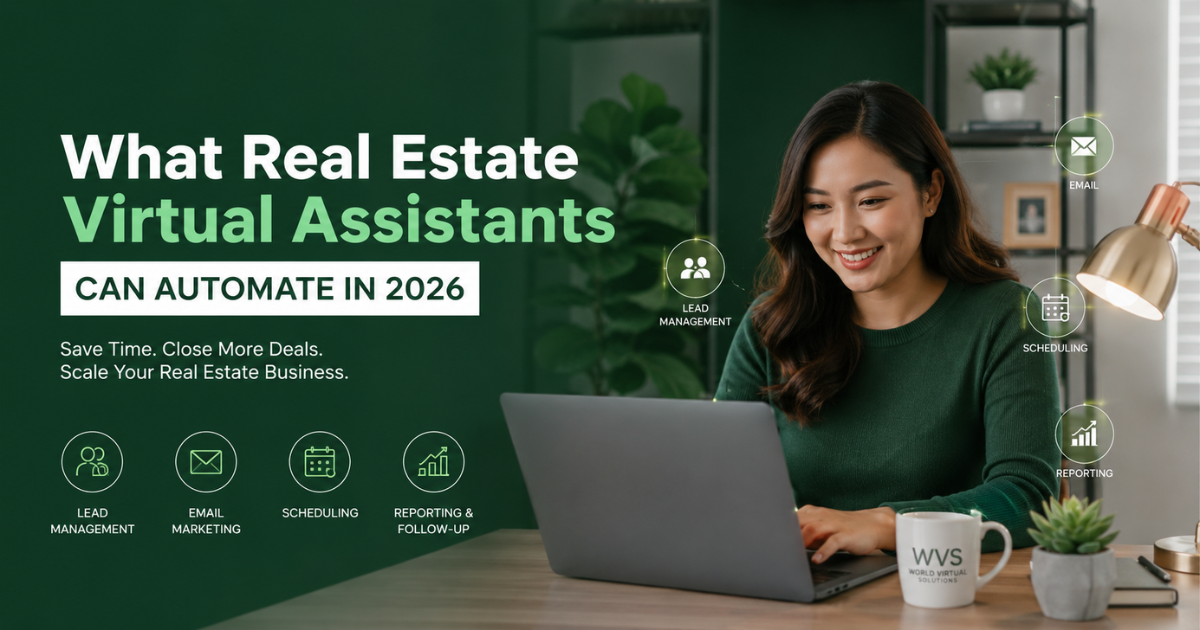
What Real Estate Virtual Assistants Can Automate in 2026
ON THIS PAGE
Introduction
Real estate has always rewarded the professionals who move fastest and follow up hardest. In 2026, the definition of “fast” has changed. Artificial intelligence now handles work that used to consume entire mornings — sorting leads, drafting listing descriptions, transcribing showings, updating the CRM — in minutes, and often without a single manual click.
The agents and brokers pulling ahead aren’t the ones with the most hours in the day. They’re the ones who pair a skilled real estate virtual assistant with the right AI tools, then let that combination absorb the repetitive tasks that quietly eat into commission-generating time. This guide breaks down exactly what an AI-powered virtual assistant can automate in 2026, which tools they use, and why the smartest move isn’t replacing people with software — it’s putting trained people in charge of it.
How AI Is Reshaping Real Estate Operations in 2026
The shift underway isn’t about a single flashy app. It’s about AI moving from a novelty into the operational plumbing of a real estate business.
A few years ago, “using AI” meant occasionally asking a chatbot to reword an email. Today, generative AI drafts entire marketing campaigns, automation platforms move data between systems untouched, and meeting assistants produce clean summaries before an agent has left the parking lot. The individual tools are powerful, but the real leverage comes from stringing them together into workflows — and that’s precisely where a trained VA earns their keep.
The result is a structural change in how deals get done. Administrative work that once justified a full-time hire can now be run by one AI-fluent assistant supported by software. That frees agents and brokers to spend their time where machines still can’t compete: building relationships, negotiating, advising clients through the biggest financial decisions of their lives, and closing.
Importantly, AI hasn’t removed the need for judgment. It has raised the value of it. When drafting and data entry are cheap, the scarce, valuable skill becomes knowing what to do with the output — and that’s a human strength.
What Real Estate Virtual Assistants Can Automate in 2026
Here’s where the theory becomes practical. Below are the core functions an AI-skilled real estate VA can automate or dramatically accelerate this year.
CRM Management and Data Entry
The CRM is the engine of a real estate business, and it’s also where good intentions go to die. Contacts get entered inconsistently, notes get skipped, and follow-up tasks fall through the cracks.
An AI-powered VA can automate CRM upkeep by capturing new leads directly from web forms, portals, and inbound emails, then routing them into the correct pipeline stage. AI tools can enrich records, deduplicate entries, log call and email activity automatically, and flag contacts that have gone cold. Instead of an agent hand-typing details after every interaction, the system keeps itself current.
Lead Management and Qualification
Speed-to-lead wins deals, and it’s one of the clearest automation wins available. A VA can set up workflows that respond to new inquiries instantly — day or night — with a personalized message, then use AI to sort leads by intent and readiness.
Common automations include:
- Instant auto-responses to new inquiries so no lead sits unanswered
- AI-assisted qualification that scores leads based on budget, timeline, and engagement
- Automated nurture sequences that stay in touch with long-timeline prospects
- Alerts that push hot, sales-ready leads straight to the agent
The agent still handles the meaningful conversations — the VA and the AI make sure those conversations happen with the right people at the right time.
Email Management and Communication
Inbox overload is one of the biggest silent productivity killers in the industry. A real estate virtual assistant can triage the inbox, sort messages by priority, draft replies for routine questions, and surface only what genuinely needs the agent’s attention.
With AI writing assistants, a VA can produce polished, on-brand responses in seconds and adapt tone for a first-time buyer versus a seasoned investor. Templated but personalized follow-ups — after showings, open houses, or inspections — can go out automatically while still reading as human.
Scheduling and Calendar Coordination
Coordinating showings, inspections, closings, and client calls is a logistical grind full of back-and-forth. VAs use AI-enabled scheduling tools to offer available time slots, book appointments, send confirmations, and issue automatic reminders that reduce no-shows. When a client reschedules, the system adjusts without anyone chasing a reply.
Transaction Coordination
Transaction coordination is detail-heavy, deadline-driven, and unforgiving of mistakes. This is a natural fit for automation paired with human oversight.
An AI-skilled VA can automate the tracking of contract milestones and contingency deadlines, trigger reminders for signatures and document submissions, and keep every party — buyer, seller, lender, title, and agent — informed with status updates. AI can review documents for missing fields or inconsistencies before they cause a delay. The VA manages the exceptions and the human touchpoints; the automation handles the checklist.
Marketing and Advertising
Marketing is where AI’s creative capabilities shine and where a VA multiplies an agent’s output. A virtual assistant can generate listing descriptions, email newsletters, property flyers, and ad copy tailored to each audience, then schedule and distribute it across channels.
For a new listing, a single property can be turned into a full campaign — a description, social posts, an email blast, and a landing page — in a fraction of the time it once took, with the VA refining the AI’s drafts to match the brand voice and comply with fair housing guidelines.
Social Media Management
Consistency is the hardest part of social media, and it’s exactly what automation solves. A VA can build a content calendar, produce captions and graphics, schedule posts in advance, and repurpose one piece of content — say, a listing video — into formats for multiple platforms. AI tools speed up caption writing, hashtag research, and design, while the VA maintains a coherent, professional presence.
Content Creation
Beyond social posts, VAs use AI to produce the long-form content that builds authority: neighborhood guides, market-update blog posts, buyer and seller checklists, and video scripts. AI handles the first draft and the research scaffolding; the VA edits for accuracy, local nuance, and voice. The output is content that positions the agent or brokerage as the local expert without demanding hours of writing time.
Market Research and Analysis
Staying current on inventory, pricing trends, and comparable sales is essential and time-consuming. A VA can use AI to compile market research, summarize lengthy reports, pull together comparative market analyses, and turn raw data into a clear, client-ready summary. For a commercial broker evaluating a submarket or a residential agent prepping a listing presentation, this compresses hours of research into a reviewable brief.
Reporting and Analytics
Business owners can’t improve what they don’t measure. VAs can automate recurring reports — lead sources, conversion rates, pipeline health, marketing performance, transaction volume — and use AI to translate the numbers into plain-language insights. Instead of an agent squinting at a dashboard, they get a weekly summary that says what changed and what deserves attention.
Document Management
Real estate runs on paperwork. An AI-skilled VA can organize digital files, extract key data from contracts and disclosures, standardize naming conventions, and build searchable, well-structured document systems. AI can summarize long agreements and flag terms worth a closer look, so nothing important hides in the fine print.
AI Tools Modern Real Estate VAs Use
A skilled virtual assistant is only as effective as their toolkit — and knowing how to combine tools is a genuine skill. Here are the platforms commonly used by AI-fluent real estate VAs in 2026 and what each one does:
- ChatGPT (OpenAI): Drafting listing descriptions, emails, ad copy, and social content; summarizing documents; brainstorming campaign ideas.
- Claude (Anthropic): Long-form writing, careful document analysis, and reasoning through detailed content or contracts where nuance and accuracy matter.
- Gemini (Google): Research and content generation with tight integration into Google Workspace — useful for VAs working out of Gmail, Docs, and Sheets.
- Microsoft Copilot: AI built into Microsoft 365, assisting inside Word, Excel, Outlook, and Teams for drafting, data analysis, and email management.
- Canva AI (Magic Studio): Fast creation of branded graphics, flyers, social posts, and presentations, with AI-assisted design and copy.
- Zapier: Connecting apps and automating workflows — for example, routing a new lead from a web form into the CRM, a spreadsheet, and an email sequence automatically.
- Fireflies.ai: Recording, transcribing, and summarizing calls and meetings so notes and action items are captured without manual effort.
- Otter.ai: Real-time meeting transcription and summaries, useful for client calls, walkthroughs, and team meetings.
- Notion AI: Organizing knowledge, notes, and project documentation with AI-assisted writing and summarization inside a shared workspace.
- Grammarly: Polishing grammar, clarity, and tone so every client-facing message reads professionally.
The value isn’t any single tool. It’s a VA who knows which tool fits which job and can wire them together into a workflow that runs with minimal supervision.
The Benefits of Hiring a Virtual Assistant Trained in AI Tools
Not every virtual assistant is created equal. A VA specifically trained in AI tools delivers advantages a general admin hire can’t match:
- More output from fewer hours. AI-fluent VAs complete in minutes what used to take hours, so a single assistant can cover a wider range of responsibilities.
- Faster response times. Automated lead responses and follow-ups mean prospects never wait, which directly affects conversion.
- Lower overhead. Hiring a virtual assistant avoids the cost of full-time staff, office space, and equipment, while AI tooling extends what one person can handle.
- Consistency and fewer errors. Automated workflows don’t forget deadlines, skip follow-ups, or mistype data.
- Scalability. As deal volume grows, AI-supported systems scale without a proportional increase in staff.
- Professional, on-brand output. With the right prompts and editing, AI content maintains a consistent voice across every channel.
- More selling time for the agent. Every task the VA absorbs is time returned to prospecting, showing, negotiating, and closing.
The through-line: an AI-trained VA doesn’t just do tasks — they build systems that keep doing tasks.
Benefits for Residential Agents vs. Commercial Brokers
AI-powered virtual assistants create value on both sides of the industry, but the highest-impact use cases differ.
For Residential Agents
Residential real estate is high-volume and relationship-driven. Agents juggle many clients, tight timelines, and constant communication. An AI-powered VA helps by:
- Responding to buyer and seller inquiries instantly, around the clock
- Nurturing large databases of past clients and long-timeline leads
- Producing listing marketing — descriptions, social posts, email blasts — at speed
- Coordinating showings, open houses, and closings
- Keeping the CRM current so no lead slips away
For a solo agent or small team, this is the difference between reactively fighting the inbox and proactively working the pipeline.
For Commercial Brokers
Commercial real estate is lower-volume but far more research- and document-intensive, with longer sales cycles. An AI-powered VA supports brokers by:
- Compiling market and submarket research and summarizing complex reports
- Organizing and analyzing lengthy leases, contracts, and offering memoranda
- Building financial summaries and comparative analyses for stakeholders
- Maintaining detailed records across long, multi-party deals
- Tracking milestones and deadlines through extended transaction timelines
Where residential agents gain speed and volume, commercial brokers gain depth, organization, and analytical horsepower — without adding headcount.
Why AI Enhances — Not Replaces — Human Expertise
It’s worth being direct about a common fear: AI is not going to replace real estate professionals, and an honest assessment of the technology explains why.
AI is exceptional at pattern-based, repetitive, and generative tasks. It’s poor at the things that actually close deals — reading a nervous first-time buyer, negotiating under pressure, exercising local market judgment, and earning trust during a stressful, high-stakes transaction. Real estate remains a relationship business, and relationships are built by people.
AI also makes mistakes. It can produce confident-sounding but inaccurate output, miss context a local expert would catch, and generate content that needs a human check for compliance and tone. That’s exactly why a trained virtual assistant matters: the VA supplies the oversight, judgment, and quality control that turn raw AI output into reliable work.
The right mental model isn’t “human versus AI.” It’s a skilled professional using AI as a force multiplier. The technology handles volume and speed; the human handles judgment, relationships, and accountability. Businesses that understand this distinction get the productivity gains without the quality risks.
How AI-Powered Virtual Assistants Deliver a Competitive Advantage
In a competitive market, small operational edges compound into meaningful results. An AI-powered virtual assistant delivers advantages that are hard for slower competitors to match:
- You respond first. When your leads get an instant, personalized reply and your competitor’s inquiry sits unanswered until morning, you’ve often already won the client.
- You stay top-of-mind. Automated, consistent nurturing keeps you in front of prospects across long buying and selling cycles.
- You look bigger than you are. Professional marketing, consistent branding, and polished communication project the presence of a large team, delivered by one VA and smart tooling.
- You make better decisions faster. Automated reporting and research give you clear insight into what’s working, so you can adjust quickly.
- You protect your time. By offloading administrative load, you concentrate on the high-value activities that actually generate commissions.
The competitive advantage isn’t the AI itself — increasingly, everyone has access to the same tools. The advantage is having a skilled person who knows how to deploy those tools into workflows that consistently produce results.
Frequently Asked Questions (FAQ)
What can a real estate virtual assistant automate in 2026?
A real estate VA can automate CRM management and data entry, lead capture and qualification, email triage and follow-up, scheduling, transaction coordination, marketing, social media, content creation, market research, reporting, and document management — while a human oversees quality and handles client relationships.
Will AI replace real estate agents or virtual assistants?
No. AI automates repetitive and generative tasks, but it can’t replace human judgment, negotiation, local expertise, or relationship-building. It enhances what skilled professionals do rather than replacing them, which is why trained VAs remain essential for oversight and quality control.
What AI tools do modern real estate virtual assistants use?
Common tools include ChatGPT, Claude, Gemini, and Microsoft Copilot for writing and analysis; Canva AI for design; Zapier for workflow automation; Fireflies.ai and Otter.ai for meeting transcription; Notion AI for organization; and Grammarly for polished communication.
Is hiring an AI-skilled virtual assistant cost-effective?
For most agents and brokers, yes. A virtual assistant avoids the overhead of a full-time in-house hire, and AI tooling lets one assistant cover more ground — often making it more affordable than the tasks and lost opportunities it replaces.
Do I need to be tech-savvy to work with an AI-powered VA?
No. A skilled VA handles the tools and workflows for you. Your job is to communicate your goals and preferences; theirs is to build and run the systems that support your business.
How is a residential agent's use of a VA different from a commercial broker's?
Residential agents typically prioritize speed, lead response, and high-volume marketing, while commercial brokers lean on research, document analysis, and financial summaries for longer, more complex deals. An AI-skilled VA adapts to both.
Work Smarter in 2026 with World Virtual Solutions
The agents and brokers who win in 2026 won’t be the ones working the most hours — they’ll be the ones who built the smartest systems. AI has made it possible to automate the repetitive work that drains your day, but the technology only pays off when a skilled professional is running it.
That’s what World Virtual Solutions delivers: AI-trained real estate virtual assistants who combine the right tools with real expertise to keep your pipeline full, your marketing consistent, your transactions on track, and your time focused where it belongs — on your clients and your closings.
Stop losing hours to admin and leads to slow follow-up. Connect with World Virtual Solutions today to match with an AI-powered real estate virtual assistant and turn 2026 into your most productive year yet.
Share article
Latest Posts
Stop Wasting Hours on Repetitive Tasks.
Our dedicated, real-estate-only Virtual Assistants handle the admin — amplified by AI — so you can focus on clients and closings.
- Administrative Tasks
- CRM Management
- Lead Generation
- Transaction Coordination
- Marketing & Social Media
- AI Workflow & Automation
Free 15-min call · No commitment · Response within 2 business hours

The leading real estate virtual assistant company for agents, brokers, and teams across the US, Canada, and Australia. 100% real estate focused. Dedicated VAs. Month-to-month.
SERVICES
COMPANY
CONTACT
- info@worldvirtualsolutions.com
- +1 (213) 719 2314
- Serving US · Canada · Australia
- Responds within 2 business hours